

A Fully Updated 2026 H12-841_V1.5 Exam Dumps - PDF Questions and Testing Engine
Easy Success Huawei H12-841_V1.5 Exam in First Try
NEW QUESTION # 97
Huawei switches support VLAN assignment based on interface, MAC address, protocol, and IP address.
- A. TRUE
- B. FALSE
Answer: A
NEW QUESTION # 98
In Huawei's WAN solution, which of the following technologies can optimize the transmission experience of "cross-regional video conferencing" and reduce lag and latency? (Multiple choice)
- A. No traffic priority; video and regular data compete for bandwidth.
- B. Video traffic priority scheduling (based on DSCP tag priority forwarding of video data packets)
- C. Edge node caching (caching video streams locally to reduce long-distance transmission latency)
- D. Dynamic bandwidth adjustment (adjusting video bitrate based on link load)
- E. Fixed video bitrate, not adjusted according to link status .
Answer: B,C,D
NEW QUESTION # 99
In Huawei's SD-WAN solution, which of the following functions can "automatically switch the service forwarding path to the optimal link based on the real-time link quality (latency, packet loss rate)"?
- A. Manually switch paths
- B. Static routes with fixed paths
- C. Select path based solely on link bandwidth
- D. Dynamic path switching based on link quality
Answer: D
NEW QUESTION # 100
In Huawei's SD-WAN solution, which of the following functions can "statistically measure security indicators such as the amount of encrypted traffic and the usage rate of encryption algorithms in the VPN tunnel between branch devices and headquarters"?
- A. Equipment hardware resource monitoring
- B. Link Quality Detection (LQM)
- C. Application Traffic Classification Statistics
- D. VPN Tunnel Security Indicator Statistics and Reports
Answer: D
NEW QUESTION # 101
In a wide area network (WAN) IPv6 transition scenario, if "an enterprise needs to publish IPv6 services to the outside world, and the outside world only supports IPv4 access", which of the following technologies should be adopted?
- A. IPv4/IPv6 dual-stack technology (requires external IPv6 support)
- B. NAT46 (translates external IPv4 addresses into internal IPv6 addresses to enable access)
- C. IPv6 over IPv4 tunnel (only allows access from IPv6 terminals)
- D. DNS64+NAT64 (only enables internal IPv6 to access external IPv4)
Answer: B
NEW QUESTION # 102
(Refer to the following routing entries queried using a command on the VTEP. Which of the following statements about these routes are true?) Network(EthTagId/IpAddrLen/OriginalIp) NextHop
*>i 0:32:1.1.1.0 1.1.1.0
Route Distinguisher: 2:5
Network(EthTagId/IpAddrLen/OriginalIp) NextHop
*>i 0:32:1.1.1.0 1.1.1.0
Route Distinguisher: 2:7
Network(EthTagId/IpAddrLen/OriginalIp) NextHop
*>i 0:32:1.1.1.0 1.1.1.0
- A. These routes are Type 2 routes and carry host IP addresses.
- B. These routes are Type 3 routes. If the VTEP IP address carried in these routes is reachable at Layer 3, a VXLAN tunnel to the peer end is established.
- C. These routes are Type 3 routes. After receiving these routes, the local end creates an ingress replication list.
- D. These routes are Type 3 routes and carry the VTEP IP address.
Answer: B,C,D
Explanation:
The displayed routes are EVPN routes shown in the formatNetwork(EthTagId/IpAddrLen/OriginalIp)with a
/32 "OriginalIp" value (for example,0:32:1.1.1.0). In Huawei VXLAN BGP EVPN as described in HCIP Datacom Campus Network materials, this format corresponds toEVPN Route Type 3 (Inclusive Multicast Ethernet Tag Route). Type 3 routes are used by VTEPs to advertise participation information for a VXLAN broadcast domain (BD) and to provide the remote endpoint information needed for BUM (broadcast, unknown unicast, multicast) traffic handling.
Type 3 routes effectively carry theremote VTEP address information(the VTEP IP that serves as the tunnel destination in the underlay). Once the underlay Layer 3 network can reach that VTEP IP (for example, via IGP
/BGP underlay routes), the VXLAN overlay can build forwarding toward the peer VTEP, so statementAis true and statementDis also true.
When ingress replication is used for BUM forwarding, the local VTEP needs a replication list of remote VTEPs in the BD. Receiving Type 3 routes provides the membership information required to form this list, making statementBtrue.
StatementCis false becauseType 2routes are MAC/IP Advertisement routes that include MAC information (and optionally a host /32 IP). The shown output contains no MAC fields, so it is not Type 2.
NEW QUESTION # 103
In Huawei's SD-WAN solution, which of the following technologies can "realize dynamic negotiation of VPN tunnel encryption algorithms between branches and headquarters to adapt to different security needs"?
- A. Encryption algorithm negotiation based on the IKE protocol (supports dynamic selection of multiple algorithms such as AES and 3DES)
- B. Unencrypted VPN tunnel, relying only on link-layer security
- C. The encryption algorithm is manually configured and dynamic changes are not supported.
- D. The AES-128 encryption algorithm will be used consistently, without negotiation.
Answer: A
NEW QUESTION # 104
In Huawei's SD-WAN solution, for the scenario of " multi-tenant branch sharing of 5G links", which of the following technologies can "achieve independent billing and bandwidth control for 5G traffic of different tenants"?
- A. Only total 5G traffic is counted; tenant-specific billing is not differentiated.
- B. Create a separate traffic statistics instance for each tenant, bind it to a 5G sub-interface, and configure bandwidth quotas.
- C. Traffic is counted by tenant IP address range, without instance isolation.
- D. All tenants share 5G traffic, with unified billing and control.
Answer: B
NEW QUESTION # 105
(On a small- or medium-sized campus network deployed based on the Huawei CloudCampus Solution, if a single AP is used as the network egress and needs to be managed by iMaster NCE-Campus, in which of the following modes should the AP work?)
- A. RU
- B. Cloud
- C. Fit
- D. Fat
Answer: B
Explanation:
In the Huawei CloudCampus Solution, access points can operate in different modes depending on network size, architecture, and management requirements. For asmall- or medium-sized campus networkwhere asingle AP is used as the network egressand must becentrally managed by iMaster NCE-Campus, the recommended operating mode isCloud mode.
When an AP works inCloud mode, it establishes a direct management connection with iMaster NCE-Campus through the cloud. The AP can independently provide wireless access services while also performing gateway and egress functions, such as user traffic forwarding and policy enforcement. This eliminates the need to deploy a dedicated wireless AC or additional gateway devices, significantly simplifying network architecture and reducing deployment cost.
Fit modeAPs rely on a local or centralized AC for control and therefore cannot independently function as a network egress.RU modeis used only in Agile Distributed Wi-Fi scenarios and depends on a central AP, making it unsuitable for this scenario.Fat modeAPs can operate independently but lack deep integration with iMaster NCE-Campus for cloud-based centralized management and automated service provisioning.
HCIP Datacom Campus Network documentation highlights Cloud APs as the optimal choice for small and medium campuses that require simplified deployment, cloud-based management, and integrated gateway capabilities. Therefore, to meet both the management and egress requirements described, the AP should operate inCloud mode.
Hence, the correct answer isC.
NEW QUESTION # 106
(Refer to the figure.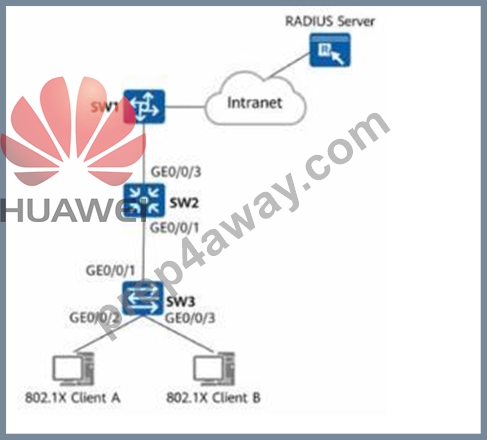
Which of the following steps aremandatoryto enable 802.1X authentication on GE0/0/2 and GE0/0/3 of SW3 and configure a RADIUS server to authenticate and deliver network access rights to users?Choose all that apply.)
- A. Configure an 802.1X access profile.
- B. Configure an AAA scheme.
- C. Configure an authentication domain.
- D. Configure an authentication profile.
Answer: A,B,C,D
Explanation:
Comprehensive and Detailed 200 to 250 words of Explanation From HCIP Datacom Campus Network documents knowledge without any URL or Links:
To deploy802.1X authenticationon Huawei campus switches and use aRADIUS serverfor user authentication and authorization, several core configuration components are mandatory. All four options listed are required for a complete and functional deployment.
Anauthentication domainis mandatory because it defines where user authentication requests are processed and which AAA schemes are used. Without a domain, the switch cannot determine how to handle authentication requests, makingoption A mandatory.
Anauthentication profileis also required. This profile binds authentication methods (such as 802.1X), authentication domains, and access policies together. Interfaces reference the authentication profile to determine how users are authenticated, sooption B is mandatory.
An802.1X access profiledefines detailed 802.1X parameters, such as authentication mode, reauthentication behavior, and client handling. This profile is bound to interfaces to enable 802.1X authentication on specific ports, makingoption C mandatory.
Finally, anAAA schemeis essential because it defines the authentication, authorization, and accounting methods used by the device, including RADIUS server configuration. Without an AAA scheme, the device cannot communicate with the RADIUS server or obtain user authorization information. Therefore,option D is mandatory.
According to HCIP Datacom Campus Network documentation, all four configuration steps are required to successfully enable 802.1X authentication with RADIUS-based access control.
NEW QUESTION # 107
(Which of the following is not an advantage of Huawei CloudCampus solution?)
- A. Supports free mobility
- B. Supports plug-and-play of devices
- C. Supports automatic deployment of physical networks
- D. Unified management of Huawei switches, routers, and storage servers
Answer: D
Explanation:
Huawei CloudCampus is an intelligent campus network solution designed to simplify deployment, improve O&M efficiency, and enhance user experience through cloud-based and automated technologies. Its advantages mainly focus onnetwork automation, unified management of campus network devices, and intelligent services, rather than full IT infrastructure management.
Option A is a core advantage of CloudCampus. Through cloud-based controllers and automation technologies, CloudCampus supportsautomatic deployment of physical networks, reducing manual configuration and shortening service rollout time.
Option B is also an important advantage. CloudCampus supportsplug-and-play of devices, where network devices can automatically go online, download configurations, and complete provisioning after being powered on and connected, significantly reducing on-site workload.
Option D is another key feature. Cloud Campus supportsfree mobility, allowing users to roam across different access points or areas while maintaining consistent network access policies and service experience, which is especially important in modern wireless campus environments.
Option C isnot an advantageof the Huawei Cloud Campus solution. Cloud Campus focuses on unified management ofcampus network devicessuch as switches, routers, and wireless devices. It does not provide unified management forstorage servers, which fall outside the scope of campus network management and belong to data center or IT infrastructure management solutions.
Therefore, unified management of Huawei switches, routers, and storage servers is not an advantage of the Cloud Campus solution.
NEW QUESTION # 108
In Huawei's WAN solution, regarding the issue of "echoes in cross-regional voice services (VoIP)," which of the following troubleshooting steps should be performed first?
- A. Check if the link bandwidth is sufficient.
- B. Check if echo cancellation is enabled on the VoIP gateway.
- C. Check if the routing table of the CE device includes the VoIP server network segment.
- D. Check if the MPLS LSP of the PE device is established.
Answer: B
NEW QUESTION # 109
(Which of the following statements about the fabric global resource pool isfalse?)
- A. A bridge domain is a Layer 2 broadcast domain used to forward data packets on a VXLAN.
- B. VLANs for connecting to external networks, VLANs for connecting to network service resources, and VLANs for connecting underlay devices are allocated from the VLAN resource pool.
- C. A VXLAN network identifier identifies a VXLAN.
- D. Configure a service VLAN pool when you need to configure external gateway interconnection VLANs, network service resource interconnection VLANs, management VLANs for policy association, and VN access VLANs.
Answer: B
Explanation:
Comprehensive and Detailed 200 to 250 words of Explanation From HCIP Datacom Campus Network documents knowledge without any URL or Links:
In a CloudCampus VXLAN fabric, theglobal resource poolcentrally manages identifiers such as VLANs, VNIs, and bridge domains to ensure consistent allocation across the fabric.
StatementAis correct because abridge domain (BD)is the VXLAN equivalent of a VLAN and represents a Layer 2 broadcast domain used for packet forwarding within a VXLAN network.
StatementCis also correct. AVXLAN Network Identifier (VNI)uniquely identifies a VXLAN segment and is a core VXLAN forwarding identifier.
StatementDis correct because theservice VLAN poolis used to allocate VLANs for multiple purposes, including external gateway interconnections, network service resource interconnections, policy association management, and VN access VLANs.
StatementBis false. VLANs used forunderlay device interconnectionsarenot allocated from the VLAN resource poolmanaged by the VXLAN fabric. Underlay VLANs belong to the traditional IP underlay network and are typically planned and configured independently. The VLAN resource pool is intended for overlay-related services and fabric-managed VLAN usage only.
Therefore, the incorrect statement isB.
NEW QUESTION # 110
(The Huawei CloudCampus Solution divides the network architecture into three layers: network layer, management layer, and application layer.)
- A. FALSE
- B. TRUE
Answer: A
Explanation:
Comprehensive and Detailed 200 to 250 words of Explanation From HCIP Datacom Campus Network documents knowledge without any URL or Links:
The Huawei CloudCampus Solution adopts afour-layer architecture, not a three-layer one. According to HCIP Datacom Campus Network documentation, the architecture consists of theterminal layer,network layer,management and control layer, andapplication layer.
Theterminal layerincludes user devices such as PCs, mobile terminals, IoT devices, and other endpoints that access the campus network. Thenetwork layeris responsible for data forwarding and includes access, aggregation, and core network devices. Themanagement and control layer, represented by platforms such as iMaster NCE-Campus, provides centralized management, automation, policy control, and orchestration. The application layerdelivers value-added services and business applications.
Because the terminal layer is an essential and explicitly defined component of the CloudCampus architecture, stating that the solution has only three layers is incorrect. Therefore, the statement isFALSE, making optionB the correct answer.
NEW QUESTION # 111
In the WAN BGP protocol, if "EBGP neighbors are configured with MD5 key authentication, but the keys are inconsistent," which of the following problems will this cause?
- A. BGP neighbor relationships are established normally, and route transmission is unaffected.
- B. BGP neighbor relationships are established normally, but routes cannot be transmitted.
- C. BGP neighbor relationships could not be established (authentication failed).
- D. Automatically switches to unauthenticated mode, and neighbor relationships are established normally.
Answer: C
NEW QUESTION # 112
In Huawei's WAN bandwidth optimization solution, for "cross-regional transmission of office collaboration tool traffic (such as Lark, DingTalk)," which of the following technologies can
"optimize collaborative data transmission and reduce file transfer latency"?
- A. Collaborative data is transmitted directly without optimization.
- B. Collaborative data edge caching (frequently used files are cached at edge nodes) + transmission protocol optimization
- C. Transmitting collaborative data only during off-peak hours affects real-time performance.
- D. Limit the bandwidth of collaboration tools to prioritize other services.
Answer: B
NEW QUESTION # 113
(VXLAN identifies tenants using VNIs, which are 24 bits long. A tenant can have one or more VNIs, and VXLAN supports a maximum of 12 million tenants.)
- A. FALSE
- B. TRUE
Answer: A
Explanation:
VXLAN uses theVXLAN Network Identifier (VNI)to identify and isolate virtual Layer 2 or Layer 3 networks in an overlay environment. The VNI field is24 bits long, which allows a theoretical maximum of2²# (approximately 16 million) VNIs. This is a significant improvement over traditional VLAN technology, which supports only 4094 VLAN IDs, and is one of the main reasons VXLAN is adopted in large-scale campus and data center networks.
It is correct thata tenant can be mapped to one or more VNIs. For example, a tenant may use multiple VNIs to represent different broadcast domains or service segments, such as separate VNIs for different subnets or application tiers. However, the statement becomes incorrect when it claims that VXLAN supports a maximum of12 million tenants.
VXLAN does not directly define a fixed maximum number of tenants. VNIs represent virtual networks, not tenants themselves. The actual number of tenants supported depends on how VNIs are allocated and how the network design maps tenants to VNIs. In theory, the upper limit of VNIs is close to 16 million, not 12 million, and the number of tenants is typically much lower and design-dependent.
Therefore, while the description of VNIs being 24 bits long is correct, the conclusion about supporting a maximum of 12 million tenants is incorrect, making the overall statement false.
NEW QUESTION # 114
In troubleshooting MPLS VPN networks, if you need to "view detailed information about BGP VPNv4 neighbors on the PE device (such as neighbor status and establishment time)," which of the following commands should you use?
- A. display ip routing-table vpn -instance
- B. display bgp vpnv4 peer [neighbor IP] verbose
- C. display bgp vpnv4 all routes
- D. display mpls lsp
Answer: B
NEW QUESTION # 115
In an MPLS VPN network, which of the following descriptions conforms to the allocation logic of
"public network labels"?
- A. Assigned by the PE device based on the CE device's IP address, used for VPN instance identification.
- B. Dynamically allocated by PE/P devices via the MPLS LDP protocol, used for backbone network forwarding path identifiers.
- C. Assigned by the CE device based on the VPN instance, used to identify the VPN service type.
- D. Fixed to a preset value, not adjusted with changes in network topology.
Answer: B
NEW QUESTION # 116
In the Huawei SD-WAN iMaster NCE-WAN management platform, which of the following functions can "simulate different link failure scenarios (such as internet link interruption) to test whether service switching is normal"?
- A. Bandwidth usage statistics
- B. Configure compliance checks
- C. Network Fault Simulation and Drills
- D. Equipment hardware failure alarm
Answer: C
NEW QUESTION # 117
In an MPLS VPN network, when CE devices and PE devices exchange routes, which of the following protocols is NOT suitable for scenarios with "a large number of routes and frequent dynamic updates"?
- A. RIP
- B. OSPF
- C. BGP
- D. Static Routing
Answer: D
NEW QUESTION # 118
In MPLS VPN network troubleshooting, if "the PE device has learned the remote CE route, but the local CE device still cannot ping the remote CE", which of the following troubleshooting steps should be performed first?
- A. Check if the BGP VPNv4 neighbor between PE devices is established normally.
- B. Check if the MPLS LSP is established on the P device.
- C. Check if the operating system of the remote CE device is running normally.
- D. Check if the IP address of the VPN instance interface on the local PE device is on the same network segment as the CE device.
Answer: D
NEW QUESTION # 119
In an MPLS VPN network, which of the following faults will cause "the PE device to be unable to encapsulate public network labels for VPN packets"?
- A. BGP VPNv4 neighbor between PE devices is established normally.
- B. The VPN instance has been correctly created and the interface bound on the PE device.
- C. The MPLS LDP protocol is enabled on the PE device, and a neighbor relationship has been established with the P device.
- D. The MPLS LSP between the PE device and the P device has not been established.
Answer: D
NEW QUESTION # 120
In MPLS VPN network troubleshooting, if it is necessary to "view the ARP table of the VPN instance on the PE device to confirm whether the CE device's MAC address is being learned normally", which of the following commands should be used?
- A. Display IP routing-table VPN instance [instance name]
- B. display arp VPN instance [instance name]
- C. display bgp vpnv4 all routes
- D. display mpls lsp
Answer: B
NEW QUESTION # 121
......
H12-841_V1.5 Study Material, Preparation Guide and PDF Download: https://actualtests.prep4away.com/Huawei-certification/braindumps.H12-841_V1.5.ete.file.html