

100% Passing Guarantee - Brilliant 312-50v13 Exam Questions PDF [Apr-2025]
312-50v13 Dumps 2025 - NewECCouncil 312-50v13 Exam Questions
NEW QUESTION # 248
An organization has been experiencing intrusion attempts despite deploying an Intrusion Detection System (IDS) and Firewalls. As a Certified Ethical Hacker, you are asked to reinforce the intrusion detection process and recommend a better rule-based approach. The IDS uses Snort rules and the new recommended tool should be able to complement it. You suggest using YARA rules with an additional tool for rule generation. Which of the following tools would be the best choice for this purpose and why?
- A. yarGen - Because it generates YARA rules from strings identified in malware files while removing strings that also appear in goodware files
- B. koodous - Because it combines social networking with antivirus signatures and YARA rules to detect malware
- C. YaraRET - Because it helps in reverse engineering Trojans to generate YARA rules
- D. AutoYara - Because it automates the generation of YARA rules from a set of malicious and benign files
Answer: A
Explanation:
YARA rules are a powerful way to detect and classify malware based on patterns, signatures, and behaviors.
They can be used to complement Snort rules, which are mainly focused on network traffic analysis. However, writing YARA rules manually can be time-consuming and error-prone, especially when dealing with large and diverse malware samples. Therefore, using a tool that can automate or assist the generation of YARA rules can be very helpful for ethical hackers.
Among the four options, yarGen is the best choice for this purpose, because it generates YARA rules from strings identified in malware files while removing strings that also appear in goodware files. This way, yarGen can reduce the false positives and increase the accuracy of the YARA rules. yarGen also supports various features, such as whitelisting, scoring, wildcards, and regular expressions, to improve the quality and efficiency of the YARA rules.
The other options are not as suitable as yarGen for this purpose. AutoYara is a tool that automates the generation of YARA rules from a set of malicious and benign files, but it does not perform any filtering or optimization of the strings, which may result in noisy and ineffective YARA rules. YaraRET is a tool that helps in reverse engineering Trojans to generate YARA rules, but it is limited to a specific type of malware and requires manual intervention and analysis. koodous is a platform that combines social networking with antivirus signatures and YARA rules to detect malware, but it is not a tool for generating YARA rules, rather it is a tool for sharing and collaborating on YARA rules. References:
* yarGen - A Tool to Generate YARA Rules
* YARA Rules: The Basics
* Why master YARA: from routine to extreme threat hunting cases
NEW QUESTION # 249
Sophia is a shopping enthusiast who spends significant time searching for trendy outfits online. Clark, an attacker, noticed her activities several times and sent a fake email containing a deceptive page link to her social media page displaying all-new and trendy outfits. In excitement, Sophia clicked on the malicious link and logged in to that page using her valid credentials. Which of the following tools is employed by Clark to create the spoofed email?
- A. PyLoris
- B. Slowloris
- C. PLCinject
- D. Evilginx
Answer: D
Explanation:
Evilginx Evilginx is a man-in-the-middle attack framework used for phishing credentials and session cookies of any web service. It's core runs on Nginx HTTP server, which utilizes proxy_pass and sub_filter to proxy and modify HTTP content, while intercepting traffic between client and server.
NEW QUESTION # 250
Annie, a cloud security engineer, uses the Docker architecture to employ a client/server model in the application she is working on. She utilizes a component that can process API requests and handle various Docker objects, such as containers, volumes. Images, and networks. What is the component of the Docker architecture used by Annie in the above scenario?
- A. Docker daemon
- B. Docker objects
- C. Docker client
- D. Docker registries
Answer: A
Explanation:
Docker uses a client-server design. The docker client talks to the docker daemon, that will the work of building, running, and distributing your docker containers. The docker client and daemon will run on the same system, otherwise you will connect a docker consumer to a remote docker daemon. The docker consumer and daemon communicate using a REST API, over OS sockets or a network interface.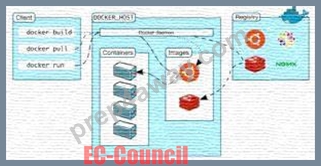
The docker daemon (dockerd) listens for docker API requests and manages docker objects like pictures, containers, networks, and volumes. A daemon may communicate with other daemons to manage docker services.
NEW QUESTION # 251
Your company suspects a potential security breach and has hired you as a Certified Ethical Hacker to investigate. You discover evidence of footprinting through search engines and advanced Google hacking techniques. The attacker utilized Google search operators to extract sensitive information. You further notice queries that indicate the use of the Google Hacking Database (GHDB) with an emphasis on VPN footprinting.
Which of the following Google advanced search operators would be the LEAST useful in providing the attacker with sensitive VPN-related information?
- A. link: This operator searches websites or pages that contain links to the specified website or page
- B. inur: This operator restricts the results to only the pages containing the specified word in the URL
- C. location: This operator finds information for a specific location
- D. intitle: This operator restricts results to only the pages containing the specified term in the title
Answer: C
Explanation:
The location: operator is the least useful in providing the attacker with sensitive VPN-related information, because it does not directly relate to VPN configuration, credentials, or vulnerabilities. The location: operator finds information for a specific location, such as a city, country, or region. For example, location:paris would return results related to Paris, France. However, this operator does not help the attacker to identify or access VPN servers or clients, unless they are specifically named or indexed by their location, which is unlikely.
The other operators are more useful in providing the attacker with sensitive VPN-related information, because they can help the attacker to find pages or files that contain VPN configuration, credentials, or vulnerabilities.
The intitle: operator restricts results to only the pages containing the specified term in the title. For example, intitle:vpn would return pages with VPN in their title, which may include VPN guides, manuals, or tutorials.
The inurl: operator restricts the results to only the pages containing the specified word in the URL. For example, inurl:vpn would return pages with VPN in their URL, which may include VPN login portals, configuration files, or directories. The link: operator searches websites or pages that contain links to the specified website or page. For example, link:vpn.com would return pages that link to vpn.com, which may include VPN reviews, comparisons, or recommendations. References:
* Google Search Operators: The Complete List (44 Advanced Operators)
* Footprinting through search engines
* Module 02: Footprinting and Reconnaissance
NEW QUESTION # 252
What kind of detection techniques is being used in antivirus softwares that identifies malware by collecting data from multiple protected systems and instead of analyzing files locally it's made on the premiers environment-
- A. Heuristics based
- B. Behaviour based
- C. Honypot based
- D. VCloud based
Answer: D
NEW QUESTION # 253
A large enterprise has been experiencing sporadic system crashes and instability, resulting in limited access to its web services. The security team suspects it could be a result of a Denial of Service (DoS) attack. A significant increase in traffic was noticed in the network logs, with patterns suggesting packet sizes exceeding the prescribed size limit. Which among the following DoS attack techniques best describes this scenario?
- A. Pulse wave attack
- B. Ping of Death attack
- C. Smurf attack
- D. UDP flood attack
Answer: B
Explanation:
A Ping of Death attack is a type of DoS attack that exploits a vulnerability in the IP protocol that allows packets to be fragmented and reassembled at the destination. The attacker sends a malformed packet that exceeds the maximum size of 65,535 bytes, which causes the target system to crash or become unstable when it tries to reassemble the packet. This attack can affect various operating systems and devices, such as routers, switches, and firewalls. A Ping of Death attack can be detected by monitoring the network traffic for unusually large packets or ICMP messages. References:
* Ping of Death (PoD) Attack
* Denial-of-Service Attacks: History, Techniques & Prevention
* What is a denial-of-service (DoS) attack?
NEW QUESTION # 254
In order to tailor your tests during a web-application scan, you decide to determine which web-server version is hosting the application. On using the sV flag with Nmap. you obtain the following response:
80/tcp open http-proxy Apache Server 7.1.6
what Information-gathering technique does this best describe?
- A. Dictionary attack
- B. Banner grabbing
- C. WhOiS lookup
- D. Brute forcing
Answer: B
Explanation:
Banner grabbing is a technique wont to gain info about a computer system on a network and the services running on its open ports. administrators will use this to take inventory of the systems and services on their network. However, an to find will use banner grabbing so as to search out network hosts that are running versions of applications and operating systems with known exploits.
Some samples of service ports used for banner grabbing are those used by Hyper Text Transfer Protocol (HTTP), File Transfer Protocol (FTP), and Simple Mail Transfer Protocol (SMTP); ports 80, 21, and 25 severally. Tools normally used to perform banner grabbing are Telnet, nmap and Netcat.
For example, one may establish a connection to a target internet server using Netcat, then send an HTTP request. The response can usually contain info about the service running on the host:
Graphical user interface, text, application Description automatically generated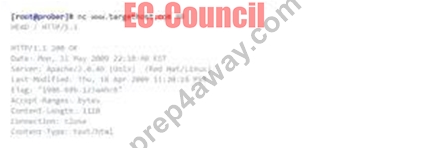
This information may be used by an administrator to catalog this system, or by an intruder to narrow down a list of applicable exploits.To prevent this, network administrators should restrict access to services on their networks and shut down unused or unnecessary services running on network hosts. Shodan is a search engine for banners grabbed from portscanning the Internet.
NEW QUESTION # 255
env x='(){ :;};echo exploit' bash -c 'cat/etc/passwd'
What is the Shellshock bash vulnerability attempting to do on a vulnerable Linux host?
- A. Changes all passwords in passwd
- B. Add new user to the passwd file
- C. Display passwd content to prompt
- D. Removes the passwd file
Answer: C
NEW QUESTION # 256
Kevin, a professional hacker, wants to penetrate CyberTech Inc.'s network. He employed a technique, using which he encoded packets with Unicode characters. The company's IDS cannot recognize the packet, but the target web server can decode them.
What is the technique used by Kevin to evade the IDS system?
- A. Desynchronization
- B. Obfuscating
- C. Urgency flag
- D. Session splicing
Answer: B
Explanation:
Adversaries could decide to build an possible or file difficult to find or analyze by encrypting, encoding, or otherwise obfuscating its contents on the system or in transit. this is often common behavior which will be used across totally different platforms and therefore the network to evade defenses.
Payloads may be compressed, archived, or encrypted so as to avoid detection. These payloads may be used throughout Initial Access or later to mitigate detection. typically a user's action could also be needed to open and Deobfuscate/Decode Files or info for User Execution. The user can also be needed to input a parole to open a parole protected compressed/encrypted file that was provided by the mortal. Adversaries can also used compressed or archived scripts, like JavaScript.
Portions of files can even be encoded to cover the plain-text strings that will otherwise facilitate defenders with discovery. Payloads can also be split into separate, ostensibly benign files that solely reveal malicious practicality once reassembled.
Adversaries can also modify commands dead from payloads or directly via a Command and Scripting Interpreter. surroundings variables, aliases, characters, and different platform/language specific linguistics may be wont to evade signature based mostly detections and application management mechanisms.
NEW QUESTION # 257
Juliet, a security researcher in an organization, was tasked with checking for the authenticity of images to be used in the organization's magazines. She used these images as a search query and tracked the original source and details of the images, which included photographs, profile pictures, and memes. Which of the following footprinting techniques did Rachel use to finish her task?
- A. Meta search engines
- B. Google advanced search
- C. Reverse image search
- D. Advanced image search
Answer: C
Explanation:
Gathering Information using Reverse Image Search Reverse image search helps an attacker in tracking the original source and details of images, such as photographs, profile pictures, and memes Attackers can use online tools such as Google Image Search, TinEye Reverse Image Search, and Yahoo Image Search to perform reverse
NEW QUESTION # 258
Ricardo has discovered the username for an application in his targets environment. As he has a limited amount of time, he decides to attempt to use a list of common passwords he found on the Internet. He compiles them into a list and then feeds that list as an argument into his password-cracking application, what type of attack is Ricardo performing?
- A. Password spraying
- B. Dictionary
- C. Brute force
- D. Known plaintext
Answer: B
Explanation:
A dictionary Attack as an attack vector utilized by the attacker to break in a very system, that is password protected, by golf shot technically each word in a very dictionary as a variety of password for that system.
This attack vector could be a variety of Brute Force Attack.
The lexicon will contain words from an English dictionary and conjointly some leaked list of commonly used passwords and once combined with common character substitution with numbers, will generally be terribly effective and quick.
How is it done?
Basically, it's attempting each single word that's already ready. it's done victimization machine-controlled tools that strive all the possible words within the dictionary.
Some password Cracking Software:
* John the ripper
* L0phtCrack
* Aircrack-ng
NEW QUESTION # 259
Which definition among those given below best describes a covert channel?
- A. It is the multiplexing taking place on a communication link.
- B. It is one of the weak channels used by WEP which makes it insecure
- C. A server program using a port that is not well known.
- D. Making use of a protocol in a way it is not intended to be used.
Answer: D
NEW QUESTION # 260
Jason, an attacker, targeted an organization to perform an attack on its Internet-facing web server with the intention of gaining access to backend servers, which are protected by a firewall. In this process, he used a URL https://xyz.com/feed.php?url:externaIsile.com/feed/to to obtain a remote feed and altered the URL input to the local host to view all the local resources on the target server. What is the type of attack Jason performed In the above scenario?
- A. website defacement
- B. Server-side request forgery (SSRF) attack
- C. Web server misconfiguration
- D. web cache poisoning attack
Answer: B
Explanation:
Server-side request forgery (also called SSRF) is a net security vulnerability that allows an assaulter to induce the server-side application to make http requests to associate arbitrary domain of the attacker's choosing.
In typical SSRF examples, the attacker might cause the server to make a connection back to itself, or to other web-based services among the organization's infrastructure, or to external third-party systems.
Another type of trust relationship that often arises with server-side request forgery is where the application server is able to interact with different back-end systems that aren't directly reachable by users. These systems typically have non-routable private informatics addresses. Since the back-end systems normally ordinarily protected by the topology, they typically have a weaker security posture. In several cases, internal back-end systems contain sensitive functionality that may be accessed while not authentication by anyone who is able to act with the systems.
In the preceding example, suppose there's an body interface at the back-end url https://192.168.0.68/admin.
Here, an attacker will exploit the SSRF vulnerability to access the executive interface by submitting the following request:
POST /product/stock HTTP/1.0
Content-Type: application/x-www-form-urlencoded
Content-Length: 118
stockApi=http://192.168.0.68/admin
NEW QUESTION # 261
A company's Web development team has become aware of a certain type of security vulnerability in their Web software. To mitigate the possibility of this vulnerability being exploited, the team wants to modify the software requirements to disallow users from entering HTML as input into their Web application.
What kind of Web application vulnerability likely exists in their software?
- A. Web site defacement vulnerability
- B. Gross-site Request Forgery vulnerability
- C. Cross-site scripting vulnerability
- D. SQL injection vulnerability
Answer: C
Explanation:
There is no single, standardized classification of cross-site scripting flaws, but most experts distinguish between at least two primary flavors of XSS flaws: non-persistent and persistent. In this issue, we consider the non-persistent cross-site scripting vulnerability.
The non-persistent (or reflected) cross-site scripting vulnerability is by far the most basic type of web vulnerability. These holes show up when the data provided by a web client, most commonly in HTTP query parameters (e.g. HTML form submission), is used immediately by server-side scripts to parse and display a page of results for and to that user, without properly sanitizing the content.
Because HTML documents have a flat, serial structure that mixes control statements, formatting, and the actual content, any non-validated user-supplied data included in the resulting page without proper HTML encoding, may lead to markup injection. A classic example of a potential vector is a site search engine: if one searches for a string, the search string will typically be redisplayed verbatim on the result page to indicate what was searched for. If this response does not properly escape or reject HTML control characters, a cross- site scripting flaw will ensue.
NEW QUESTION # 262
In the process of footprinting a target website, an ethical hacker utilized various tools to gather critical information. The hacker encountered a target site where standard web spiders were ineffective due to a specific file in its root directory. However, they managed to uncover all the files and web pages on the target site, monitoring the resulting incoming and outgoing traffic while browsing the website manually. What technique did the hacker likely employ to achieve this?
- A. Examining HTML source code and cookies
- B. User-directed spidering with tools like Burp Suite and WebScarab
- C. Using Photon to retrieve archived URLs of the target website from archive.org
- D. Using the Netcraft tool to gather website information
Answer: B
Explanation:
User-directed spidering is a technique that allows the hacker to manually browse the target website and use a proxy or spider tool to capture and analyze the traffic. This way, the hacker can discover hidden or dynamic content that standard web spiders may miss due to a specific file in the root directory, such as robots.txt, that instructs them not to crawl certain pages or directories. User-directed spidering can also help the hacker to bypass authentication or authorization mechanisms, as well as identify vulnerabilities or sensitive information in the target website. User-directed spidering can be performed with tools like Burp Suite and WebScarab, which are web application security testing tools that can intercept, modify, and replay HTTP requests and responses, as well as perform various attacks and scans on the target website.
The other options are not likely to achieve the same results as user-directed spidering. Using Photon to retrieve archived URLs of the target website from archive.org may provide some historical information about the website, but it may not reflect the current state or content of the website. Using the Netcraft tool to gather website information may provide some general information about the website, such as its IP address, domain name, server software, or hosting provider, but it may not reveal the specific files or web pages on the website. Examining HTML source code and cookies may provide some clues about the website's structure, functionality, or user preferences, but it may not expose the hidden or dynamic content that user-directed spidering can discover. References:
* User Directed Spidering with Burp
* Web Spidering - What Are Web Crawlers & How to Control Them
* Web Security: Recon
* Mapping the Application for Penetrating Web Applications - 1
NEW QUESTION # 263
When considering how an attacker may exploit a web server, what is web server footprinting?
- A. When an attacker gathers system-level data, including account details and server names
- B. When an attacker creates a complete profile of the site's external links and file structures
- C. When an attacker uses a brute-force attack to crack a web-server password
- D. When an attacker implements a vulnerability scanner to identify weaknesses
Answer: A
NEW QUESTION # 264
The security administrator of ABC needs to permit Internet traffic in the host 10.0.0.2 and UDP traffic in the host
10.0.0.3. He also needs to permit all FTP traffic to the rest of the network and deny all other traffic. After he applied his ACL configuration in the router, nobody can access the ftp, and the permitted hosts cannot access the Internet. According to the next configuration, what is happening in the network?
access-list 102 deny tcp any any
access-list 104 permit udp host 10.0.0.3 any
access-list 110 permit tcp host 10.0.0.2 eq www any
access-list 108 permit tcp any eq ftp any
- A. The first ACL is denying all TCP traffic and the other ACLs are being ignored by the router
- B. The ACL 104 needs to be first because is UDP
- C. The ACL for FTP must be before the ACL 110
- D. The ACL 110 needs to be changed to port 80
Answer: A
Explanation:
https://www.cisco.com/c/en/us/support/docs/ip/access-lists/26448-ACLsamples.html Since the first line prohibits any TCP traffic (access-list 102 deny tcp any any), the lines below will simply be ignored by the router. Below you will find the example from CISCO documentation.
This figure shows that FTP (TCP, port 21) and FTP data (port 20) traffic sourced from NetB destined to NetA is denied, while all other IP traffic is permitted.
Diagram Description automatically generated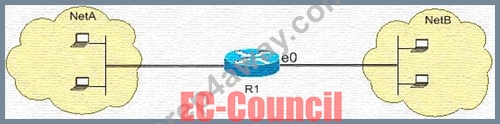
FTP uses port 21 and port 20. TCP traffic destined to port 21 and port 20 is denied and everything else is explicitly permitted.
* access-list 102 deny tcp any any eq ftp
* access-list 102 deny tcp any any eq ftp-data
* access-list 102 permit ip any any
NEW QUESTION # 265
Allen, a professional pen tester, was hired by xpertTech solutWns to perform an attack simul-ation on the organization's network resources. To perform the attack, he took advantage of the NetBIOS API and targeted the NetBIOS service. B/enumerating NetBIOS, he found that port 139 was open and could see the resources that could be accessed or viewed on a remote system. He came across many NetBIOS codes during enumeration.
identify the NetBIOS code used for obtaining the messenger service running for the logged-in user?
- A. <20>
- B. <00>
- C. <03>
- D. <1B>
Answer: C
Explanation:
<03>Windows Messenger administrationCourier administration is an organization based framework notice Windows administration by Microsoft that was remembered for some prior forms of Microsoft Windows.
This resigned innovation, despite the fact that it has a comparable name, isn't connected in any capacity to the later, Internet-based Microsoft Messenger administration for texting or to Windows Messenger and Windows Live Messenger (earlier named MSN Messenger) customer programming.
The Messenger Service was initially intended for use by framework managers to tell Windows clients about their networks.[1] It has been utilized malevolently to introduce spring up commercials to clients over the Internet (by utilizing mass-informing frameworks which sent an ideal message to a predetermined scope of IP addresses). Despite the fact that Windows XP incorporates a firewall, it isn't empowered naturally. Along these lines, numerous clients got such messages. Because of this maltreatment, the Messenger Service has been debilitated as a matter of course in Windows XP Service Pack 2.
NEW QUESTION # 266
In the field of cryptanalysis, what is meant by a "rubber-hose" attack?
- A. Extraction of cryptographic secrets through coercion or torture.
- B. A backdoor placed into a cryptographic algorithm by its creator.
- C. Attempting to decrypt ciphertext by making logical assumptions about the contents of the original plaintext.
- D. Forcing the targeted keystream through a hardware-accelerated device such as an ASIC.
Answer: A
Explanation:
A powerful and often the most effective cryptanalysis method in which the attack is directed at the most vulnerable link in the cryptosystem - the person. In this attack, the cryptanalyst uses blackmail, threats, torture, extortion, bribery, etc. This method's main advantage is the decryption time's fundamental independence from the volume of secret information, the length of the key, and the cipher's mathematical strength.
The method can reduce the time to guess a password, for example, for AES, to an acceptable level; however, it requires special authorization from the relevant regulatory authorities. Therefore, it is outside the scope of this course and is not considered in its practical part.
NEW QUESTION # 267
John, a professional hacker, targeted an organization that uses LDAP for accessing distributed directory services. He used an automated tool to anonymously query the IDAP service for sensitive information such as usernames. addresses, departmental details, and server names to launch further attacks on the target organization.
What is the tool employed by John to gather information from the IDAP service?
- A. jxplorer
- B. EarthExplorer
- C. Zabasearch
- D. Ike-scan
Answer: A
Explanation:
JXplorer could be a cross platform LDAP browser and editor. it's a standards compliant general purpose LDAP client which will be used to search, scan and edit any commonplace LDAP directory, or any directory service with an LDAP or DSML interface.
It is extremely flexible and can be extended and custom in a very number of the way. JXplorer is written in java, and also the source code and source code build system ar obtainable via svn or as a packaged build for users who wish to experiment or any develop the program.
JX is is available in 2 versions; the free open source version under an OSI Apache two style licence, or within the JXWorkBench Enterprise bundle with inbuilt reporting, administrative and security tools.
JX has been through a number of different versions since its creation in 1999; the foremost recent stable release is version 3.3.1, the August 2013 release.
JXplorer could be a absolutely useful LDAP consumer with advanced security integration and support for the harder and obscure elements of the LDAP protocol. it's been tested on Windows, Solaris, linux and OSX, packages are obtainable for HPUX, AIX, BSD and it should run on any java supporting OS.
NEW QUESTION # 268
Jane is working as a security professional at CyberSol Inc. She was tasked with ensuring the authentication and integrity of messages being transmitted in the corporate network. To encrypt the messages, she implemented a security model in which every user in the network maintains a ring of public keys. In this model, a user needs to encrypt a message using the receiver's public key, and only the receiver can decrypt the message using their private key. What is the security model implemented by Jane to secure corporate messages?
- A. Secure Socket Layer (SSL)
- B. Transport Layer Security (TLS)
- C. Zero trust network
- D. Web of trust (WOT)
Answer: D
NEW QUESTION # 269
Don, a student, came across a gaming app in a third-party app store and Installed it. Subsequently, all the legitimate apps in his smartphone were replaced by deceptive applications that appeared legitimate. He also received many advertisements on his smartphone after Installing the app. What is the attack performed on Don in the above scenario?
- A. Clickjacking
- B. Agent Smith attack
- C. SMS phishing attack
- D. SIM card attack
Answer: B
Explanation:
Agent Smith Attack
Agent Smith attacks are carried out by luring victims into downloading and installing malicious apps designed and published by attackers in the form of games, photo editors, or other attractive tools from third-party app stores such as 9Apps. Once the user has installed the app, the core malicious code inside the application infects or replaces the legitimate apps in the victim's mobile device C&C commands. The deceptive application replaces legitimate apps such as WhatsApp, SHAREit, and MX Player with similar infected versions. The application sometimes also appears to be an authentic Google product such as Google Updater or Themes. The attacker then produces a massive volume of irrelevant and fraudulent advertisements on the victim's device through the infected app for financial gain. Attackers exploit these apps to steal critical information such as personal information, credentials, and bank details, from the victim's mobile device through C&C commands.
NEW QUESTION # 270
Which of the following provides a security professional with most information about the system's security posture?
- A. Social engineering, company site browsing tailgating
- B. Wardriving, warchalking, social engineering
- C. Phishing, spamming, sending trojans
- D. Port scanning, banner grabbing service identification
Answer: D
NEW QUESTION # 271
......
Free 312-50v13 braindumps download: https://actualtests.prep4away.com/ECCouncil-certification/braindumps.312-50v13.ete.file.html